Main Content
Mycotoxins
Mycotoxins
There are legal limits for fusarium mycotoxins deoxynivalenol (DON) and zearalenone (ZON) in wheat intended for human consumption and guidance limits for feed grain. The owner (farmer, merchant or processor) is legally obliged to ensure the grain is safe for human consumption.
The following tools and information have been produced by HGCA to help growers assess mycotoxin risk and obtain composite and representative samples for testing for DON and ZON where required by the end-user.
Stage 1: Assess mycotoxin risk
A mycotoxin risk assessment score must be recorded on the Combinable Crops Passport
Risk assessment tools:
- TS121 HGCA Risk assessment for fusarium mycotoxins in wheat
- Combinable Crops Passport 2011 (Valid for 2013 harvest)
- Online risk assessment
-
Mycotoxin risk assessment tool
 (1071kb)
 - VIDEO: Fusarium mycotoxins: staying in control – Simon Edwards, Harper Adams University
New This season, HGCA is doing risk assessments for selected Recommended List trial sites, these will be updated at each key step in the risk assessment
Stage 2: Obtain a representative sample
Sample at harvest according to the HGCA grain sampling worksheet. Thorough sampling gives a better understanding of your grain and can help avoid rejections and possible disputes, it also assists with grain marketing decisions.
Further information on sampling:
About Mycotoxins
Grain is susceptible to mycotoxins produced either whilst the crop is growing by Fusarium species or during storage by Penicillium species. Mycotoxins are toxic chemicals produced by specific fungi which infect crops. Different fungal species produce mycotoxins of widely varying toxicity to humans and animals; hence there are different permitted levels in foodstuffs and feed.
Field Mycotoxins
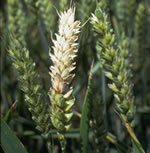 In the field, infection of ears by Fusarium species can result in mycotoxin development when the weather is warm and wet at flowering. Fusarium mycotoxin occurrence may be greater when wet weather delays harvest. Crops infected at flowering may have individual bleached spikelets, or partially bleached ears, resulting at harvest in pink or chalky-white shrivelled grains. However, there is little correlation between fusarium-damaged grains and mycotoxin occurrence.
Storage Mycotoxins
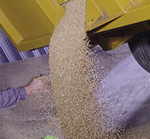 Storage fungi can grow on cereals from about 14.5% moisture content (7.5-8% in oilseed rape) upwards. They can cause heating and loss of germinative capacity and some produce mycotoxins. Ochratoxin A (OTA) may be produced by the storage mould Penicillium verrucosum if grain exceeds 18% moisture content. The greatest risk occurs during harvest backlogs and during ambient air drying when grain may take weeks to dry. OTA incidence can be unpredictable. In the UK only some strains of Penicillium verrucosum produce OTA. Even when present, those strains do not always produce toxins. .
For the field
Guidelines to minimise risk of fusarium mycotoxins in cereals
Regional in-field mycotoxin level ratings available through Crop Monitor
Research projects
Integrated strategy to prevent mycotoxin risks (Inspyr)
Improved modelling of fusarium to aid mycotoxin prediction in UK wheat
Improving risk assessment to minimise fusarium mycotoxins in harvested oats and malting barley
Useful links to other websites
Food Standards Agency
www.food.gov.uk
The UK Code of Good Agricultural Practice to Reduce Fusarium Mycotoxins in Cereals (2007) FSA
www.food.gov.uk/multimedia/pdfs/fusariumcop.pdf
The UK Code of Good Storage Practice to Reduce Ochratoxin A in Cereals (2007) FSA
www.food.gov.uk/multimedia/pdfs/ochratoxinacop.pdf
Latest News
Results for oilseed rape Recommended List trials in the East/West region are now available. As with commercial crops, the harvest of winter oilseed rape has been much delayed, but between the showers it is now well underway
Fife growers come together for new arable monitor farm project
More Headlines
Events
25 Sep 2013
The Queen Elizabeth II Conference Centre, Broad Sanctuary, London, Greater London SW1P 3EE
AHDB Crop Research Conference (Student rate)
25 Sep 2013
The Queen Elizabeth II Conference Centre, Broad Sanctuary, London, Greater London SW1P 3EE
HGCA Grain Market Outlook Conference
15 Oct 2013
The Queen Elizabeth II Conference Centre, Broad Sanctuary, London, Greater London SW1P 3EE
 Reserve place